Astronomy relies upon the collection and analysis of light which has travelled from astronomical objects such as galaxies, nebulae, stars, and even planets. Light can travel for billions of years without interference however in the past few decades due to the sudden influx in urban sprawl, light pollution has blocked this incoming light. If you have ever looked up at the night sky in the middle of the city and only seen a few specks of light, you are seeing the direct effect of light pollution from a city interfering with the light from space. This can be a big problem for astronomy as we can no longer see distant objects!
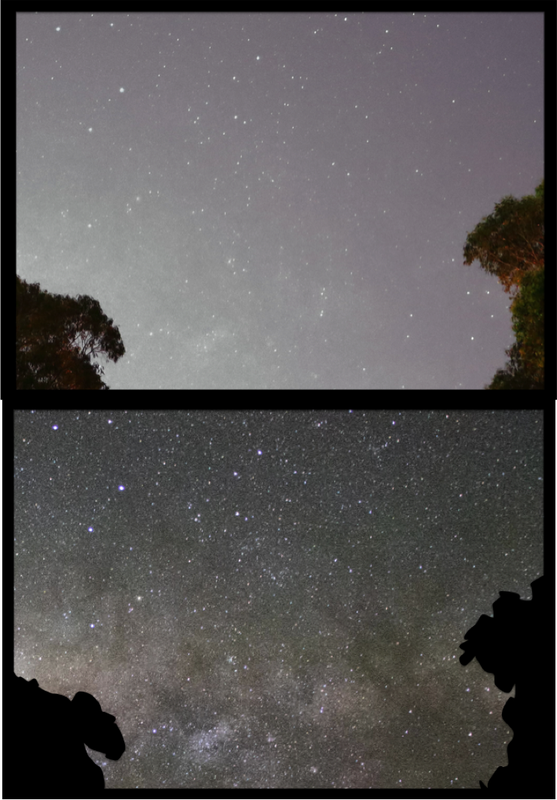
Photos taken at Macquarie University Observatory (top) with sky quality level of 19 mag/arcsec and Coonabarabran (bottom) with sky quality level of 22 mag/arcsec.
Fortunately, light pollution in Australia is not at a critical levels but in order to preserve this, the Warrumbungles National Park has been declared an International Dark Sky Park. In order to be established as a Dark Sky Park, the site must align with a set of restrictions and be eligible under the International Dark Sky Association guidelines.
This website aims to explain the importance of this designation at Warrumbungles National Park as well as provide some information on what can be done in order to reduce light pollution in urban areas. As a part of a research project conducted under the supervision of Hon Prof. Fred Watson (AAO) and Adam Joyce (Macquarie University), light pollution at Macquarie Observatory was contrasted to that at Siding Springs Observatory to highlight the importance of the Dark Sky Park Initiative.
Light Pollution
Over the years light pollution from cities, coalfields, and sports grounds, have changed the horizon of the night sky dramatically. The bright glow created by the light pollution, not only affects astronomers adversely, it also affects the native wildlife. This is seen in disoriented migratory birds and can even disrupt the reproductive cycles of the animals. Coonabarabran is the only town which has had no increase to their sky glow, due to the close ties with the observatory, the goodwill of the residents and the success of the Siding Spring Dark Skies Committee.
Both the images are taken with a 30 second exposure using a DSLR camera. They both show the accumulation of light from surrounding towns. The top image shows the northern horizon from Siding Springs Observatory, with some observatory buildings visible in the foreground. The bottom image shows the southern horizon from the same spot.
Light pollution is the culmination of different light sources, which all affect the sky, and environment, differently. This accumulation can be most attributed to poor, inefficient outdoor lighting, and the continual growth of suburban and urban areas around the country. In order to accurately compare the light pollution between urban and rural areas, a comparison should be made of the sky quality under different conditions such as moon phase and weather.
This project sought to install permanent sky quality meters which were established at both the Siding Springs Observatory and the Macquarie University Observatory. Over the course of several months reading were taken in order to determine the source of light during a night. The observations taken at Macquarie University yielded interesting results regarding the pollution from the surrounding facilities. Comparing this to the strict rules in place at the Siding Springs Observatory regarding lights demonstrates the different attitudes towards light pollutions in rural and urban areas.
Sky Quality at Macquarie University Observatory
The following are graphs extracted from the permanent sky quality meter setup at Macquarie University Observatory. In order to fully illustrate what is happening in regards to light pollution at the University, three separate nights were analysed with various weather patterns.
In Sydney, skyglow causes light from stars to be distorted which results in a light haze which settles over the urban population. On a clear night, the sky quality meter detects this skyglow and tracks a uniform level over the night. It can also be seen that the light levels slightly decrease as the night goes on. This is caused by residual glow from the Sun which dissipates throughout the course of the night until the Sun rises again.
When clouds move over the sky they act as a reflector which directs the light pollution back at the ground which has an amplification effect. This can be seen in the cloud graph as clouds move across the sky at different levels. Urban areas with significant light pollution problems are good examples of this phenomenon.
The last graph demonstrates the effect the full moon can have on an observing site. The moon doesn’t produce light but simply reflects sunlight back towards the Earth. Although unavoidable, it provides a great example of how astronomy relies on various factors to obtain the best science data.
Clear night with no clouds over head. Sky quality reaches maximum of 19 mag/arcsec.
Cloudy night where light is reflected back towards the Earth.
A clear night where a full moon passes overhead at the observatory.
Sky Quality at Siding Spring Observatory
Unlike Sydney, Coonabarabran has strict measures in place in order to reduce the skyglow produced from the population. The permanent sky quality meter installed at Siding Spring Observatory generated graphs that can be used to compare the light pollution at both locations. Below are two graphs which reflect the same conditions that were chosen at Macquarie University. When clouds pass over Siding Springs Observatory they block the light coming from the Milky Way and cause a increase in darkness. Since the surrounding areas have little to no light pollution there is no reflected light which occurs at the Sydney site.
Why You Should Care
Light pollution does not just affect astronomers and their research. Light pollution can also adversely affect humans and the wildlife of an area. Changes to local ecosystems can disrupt a town's economy as both fauna and flora are directly linked. This is why it is vital that communities come together to reduce and eliminate light pollution.
Damage to Wildlife and Ecosystems
The damage from light pollution on an ecosystem, and the wildlife in that ecosystem, has been well documented. This damage is particularly important for nocturnal animals which rely on the darkness of night to survive. For animals which are considered prey, and use the darkness to avoid predators light pollution is detrimental for their survival. The constant lighting in cities and urban areas at night changes the levels of darkness which can be comparable to day time.
Wetland habitats are also adversely affected by the glare of artificially created lights. This glare affects the breeding ritual of amphibians, which occurs at night in the darkness. These lights interfere with the reproduction of such animals which breed at night, reducing the population.
The reduction in amphibian populations is not the only reduction that can be attributed to light pollution. Turtle populations are also being affected by bright horizons. This is because when turtles hatch from their eggs, they find the ocean due to the reflection of the moon. However with cities and other urban areas expanding near the breeding grounds of turtles, the hatchlings are confused as to where the ocean is, and consequently end up heading towards the urban areas due to the lighting. This has been especially recorded in Florida, where millions die each year.
Damage to Humans
Due to the resilience of the human species, we tend to adapt more quickly to new environments which is why light pollution is so readily ignored. It is important however to understand that the severe effect of artificial lighting can have a negative effect on the circadian rhythm. This effect has been largely studied in recent years due to the increase of smartphone use after sunset. Smartphone backlight is largely dominated by blue light which mimics daylight, tricking the brain into thinking it is day and not producing melatonin. This is why it is advised to not use devices such as phones before you go to sleep. Skyglow from city lights can produce a similar effect on human populations which stall productivity and result in greater light related illnesses.
Doing Your Part
In order for the conditions at locations such as Siding Springs Observatory to be preserved, certain guidelines have been established so the public can assist with the program. Although these particular rules and regulations do not apply to residents in Sydney, everyone is able to reduce their individual contribution to light pollution by obeying certain lighting principles.
Good Lighting Practices
If you are interested in finding more information about the Dark Sky Park please click here.
About the Authors
This photo was taken at the Parkes Radio Telescope on the 29th of September 2016. Here Tash and Mikaela took a tour with the rest of the 3rd year astronomy students of the telescope.
Mikaela Tanttu is a third year Bachelor of Science student majoring in Astronomy and Astrophysics. Her passion in reducing light pollution became evident as she realised the extreme difference in skyglow at her home in the Blue Mountains and Sydney. Mikaela has strong experience in optics which assisted in the understanding of lighting principles and skyglow. At the end of her degree, Mikaela wishes to pursue a Master of Research in order to further her knowledge in astronomy. In her spare time, she designs pop culture costumes and inspires science through her love of all things science fiction.
Tash Marshall is a fourth year Bachelor of Advanced Science student specialising in Astronomy and Astrophysics. Tash runs the Macquarie University Observatory so took a keen interest in preserving the site inline with Siding Springs Observatory. This project has enabled Tash to explore ways of reducing the light pollution at Macquarie University as well in the surrounding suburbs. When she completes her degree she intends to dedicate her time to her new family and continual running of the MQ observatory.
 Photos taken at Macquarie University Observatory (top) with sky quality level of 19 mag/arcsec and Coonabarabran (bottom) with sky quality level of 22 mag/arcsec.


