COMP226 Lectures weeks 1-4 and 12-13
Just as a reminder, here are the topics of each of Mike's lectures.
(This page is updated every so often to make sure it matches what
actually happened in Mike's lectures.)
- comp226 raison d'etre, levels of analysis, overview
- Memory, registers, words, and 2's complement.
- Assembly language introduction
(text1.s)
(data.s)
- Assembly language introduction
(text2.s)
- All the assembly language we need to know
(ISEM Ref Card)
- Machine Language I (formats and loads)
(Output from od -x text1)
- The first column is addresses. The program starts on the third line.
- Machine Language II (branch displacements)
(Output from od -x text2)
- The first column is addresses. The program starts on the third line.
- More on the SPARC instruction set (jmpl, synthetics and traps)
- Subroutines and how machine code can implement recursion
- The naive recursive
Fibonacci program
(which takes 69295323 steps to calculate F(30)
(compare with your practical 4 results!))
- More on subroutines, recursion and synthetics
- Pipelining: Introduction and the hardware description language (HDL)
- Pipeline hazards: Structural, data and control
- Some
lecture notes
taken by Kang Zhang
from the pipeline lectures
- The datapath
- The pipelined datapath
- The data path and control
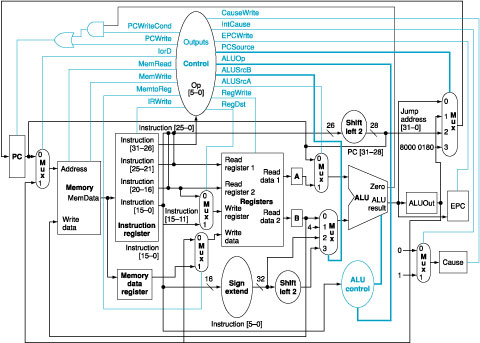
- The
datapath with control, figure 5.39 from the text
(almost identical to the diagram presented in lectures - this one is
just smaller, and some of the buses run in different directions to get
to the same destination (and it has a nice blue for control lines!)).
- Digital logic
- More digital logic
- Review and exam details
Final lecture: Discussion of the exam. Several years of exams
should be available from the library. In addition I've
located some parts of some old exams and put them on the
resources page.
mike@science.mq.edu.au 10 July 2013