Molecular and Optical Physics Laboratory (MOPL)
About MOPL
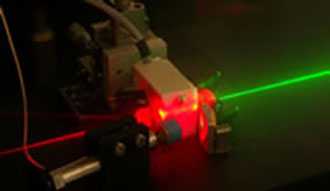
Injection-seeded optical parametric oscillators are useful for gas sensing
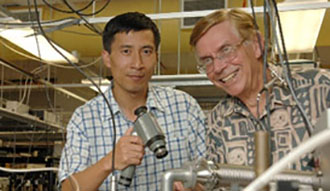
The Molecular and Optical Physics Laboratory (MOPL) is an integral part of Macquarie University's MQ Photonics Research Centre, incorporating the Centre for Lasers and Applications (CLA), established in 1988 as an Australian Commonwealth Special Research Centre. MOPL occupies a well equipped laboratory in building F7B. MOPL was previously known as the Chemistry Laser Applications Laboratory until 2003, when the research group leader, Brian Orr, became Professor of Molecular and Optical Physics and CLA Director.
| MOPL Group Leader: | Professor Brian Orr | More Details on B. Orr |
| Phone: +61-2-9850-8289; Fax: +61-2-9850-8115; E-mail: borr@science.mq.edu.au | ||
| MOPL Research Fellow: | Dr Yabai He | More details on Y. He |
| Phone: +61-2-9850-8311; Fax: +61-2-9850-8115; E-mail: yabai@science.mq.edu.au | ||
| Current MOPL research students:Richard White (PhD); Florian Englich (PhD); John Carew (BSc Honours) | ||
| MQ Photonics Research Centre | |||
| Department of Physics | |||
| Faculty of Science | Phone: | +61-2-9850-8289 | |
| Macquarie University Sydney NSW 2109 | Fax: | +61-2-9850-8115 | |
| Australia | E-mail: | borr@science.mq.edu.au |
Research @ MOPL
MOPL's research interests cover a range of topics in molecular and optical physics, applying laser and spectroscopic techniques - notably energy transfer processes, molecular spectroscopy, photochemistry, chemical analysis, nonlinear optics, biophotonics, and laser instrumentation. Recent work has focused on narrowband tunable optical parametric oscillators, novel forms of cavity ringdown spectroscopy, and rotationally resolved collision-induced molecular energy transfer. The MOPL group is now initiating a research programme on nanostructure-enhanced coherent Raman micro-spectroscopy and imaging, to investigate biomolecular processes and to detect trace chemical substances such as explosives, pathogens and forensic residues.
The MOPL group has made efforts to develop, patent, and commercialise laser-based instruments for spectroscopic sensing and imaging in industry, medicine, agriculture and the environment. Professor Brian Orr and Dr Yabai He are co-inventors of several items of laser-based intellectual property, covered by four patent applications.
MOPL offers a variety of attractive projects for postgraduate research students (PhD, MSc, Honours) in topic areas such as:
- High-performance narrowband tunable optical parametric oscillators
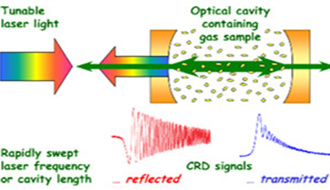
- Cavity ringdown spectroscopy for spectroscopic sensing applications
- Fundamental laser-based investigations of atomic and molecular spectroscopy
- Nanostructure-enhanced coherent Raman micro-spectroscopy and imaging of biomolecules and trace chemical substances such as explosives, pathogens and forensic residues
Such projects receive substantial funding, e.g., from the Australian Research Council. Please ask us for more specific information about projects and scholarships.
Recent publications from the MOPL research group appear in journals such as Optics Letters, Optics Express, Journal of the Optical Society of America B, Applied Optics, Applied Physics B, Journal of Chemical Physics, Journal of Physical Chemistry, and Chemical Physics Letters.
MOPL offers various attractive projects for research students (PhD, MSc, Honours).
News
This News site is currently under development
Bouncing lasers off your breath yields amazing results
CLA scientists are developing a laser device that can
sniff out diseases on people's breath.
Sydney Morning Herald
23rd October 2003
read
article >>
Sniffing
out disease
MOPL and CLA are at the forefront of research into the
development of lasers to 'sniff' diseases on a person's breath.
Macquarie University News
September 2003
read
article >>
MOPL group members have been on the conference circuit recently, attending CLEO'03 (June, Baltimore), CLEO-Europe'03 (June, Munich) and ICOLS'03 (July, Palm Cove, QLD) - presenting a total of 8 papers.
One MOPL paper on cavity ringdown sensing of CO/CO2 gas
mixtures - was selected for special media attention at
CLEO'03, due to its relevance to possible medical and industrial
applications.
June 2003